
In short: IVDD (intervertebral disc disease) is when a disc in the spine bulges or bursts and presses on the spinal cord. Long-backed, short-legged dogs carry the most risk. Know the early signs, act at once on the urgent ones, and protect the back every day: a lean body, ramps, the two-hand lift and a steady daily walk.
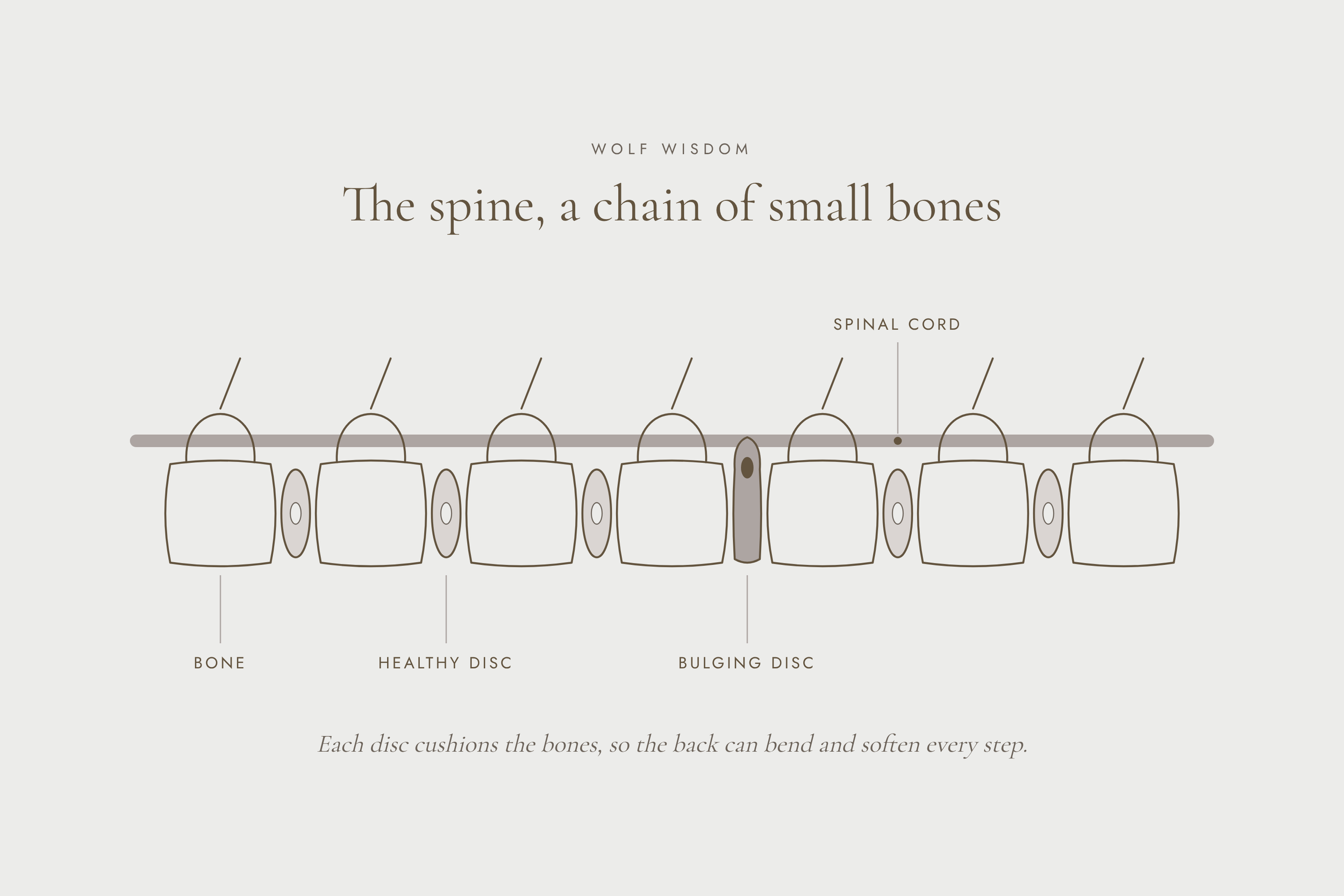
The wolf's spine was made for distance: a long, supple chain that carries the body at a steady trot, mile after mile. Between each small bone sits a cushion, so the back can bend, turn and soften every footfall. Our dogs carry the same design. In some of them, those cushions age far too early.
What is IVDD?
IVDD stands for intervertebral disc disease. Each disc has a tough outer ring and a soft, gel-like centre. In some dogs the centre dries and hardens while they are still young, and a disc can suddenly burst and press on the spinal cord. In others, usually older and larger dogs, a disc bulges slowly over months or years.
Which dogs are most at risk?
IVDD often runs in the family. Dachshunds above all, then French bulldogs, chihuahuas, beagles, cocker spaniels, Jack Russells and shih tzus. In many of these breeds, the same genes that shape the short legs also make the soft centre of each disc dry and harden early, often within the first year or two of life. Researchers have found one such gene, and it is carried by many short-legged breeds. Body shape adds to it: the Royal Veterinary College found that the longer a dog's back is compared with its height, the higher the risk. The Dachshund Breed Council's health surveys suggest around one in four dachshunds will have some back trouble in their lifetime. Any dog can be affected, but for these breeds the daily rituals below matter most.
What are the early signs?
Not wanting to jump onto the sofa or into the car, or to take the stairs
A hunched back, or the head carried low
Crying out when picked up or touched along the back
Trembling or panting at rest
A wobbly walk in the back legs
Skipping a step when walking, like a little hop in the back legs
If you see any of these, book your vet.
Which signs can't wait?
Suddenly unable to walk, or dragging the back legs
Walking on the tops of the paws
Loss of bladder or bowel control
Severe pain when moved
Call your vet or an emergency vet straight away, day or night. With the spinal cord, hours matter.
What will my vet do?
Your vet will examine your dog, test the nerves and reflexes, and may suggest a scan such as an MRI. Depending on what they find, they will advise strict rest with medication, or surgery.
What support can help recovery?
Many vets advise crate rest and pain relief, and complementary care isn't always offered, so ask about it early: physiotherapy, hydrotherapy, acupuncture and laser. Look for a local physiotherapist or rehabilitation practitioner, and do your own reading too.
What does the research say about laser?
The research is still growing, and it is encouraging. In one study, dogs given laser every day for the first five days after disc surgery were walking again in a median of 3.5 days, compared with 14 days for those without. In another, every dog given laser alongside rehabilitation, as long as deep feeling in the legs was still there, improved within 30 days. In studies of spinal cord injury in animals, laser improved movement after injury, and among athletes, a review of six trials found laser reduced pain after injury. It is a good reason to ask about laser from the very start. If your dog doesn't need surgery, the same applies: ask your vet about starting laser and other complementary care early in recovery, rather than waiting.
Comfort matters for another reason too. Pain and sleep feed each other: a body in less pain rests more deeply, with fewer sudden movements. For a healing spine, deep rest is part of the recovery.
What should I ask my vet?
Which part of the spine is affected, and how severe is it?
Is this a case for rest or for surgery, and how quickly do we need to decide?
How strict should rest be, and for how long?
Which signs mean I should call you straight away?
What should walks look like, week by week?
Which complementary care, such as laser, physiotherapy or hydrotherapy, could start now, and who do you recommend locally?
Is my dog's weight right for their spine?
What can we change at home to protect the back?
The daily rituals that protect the back
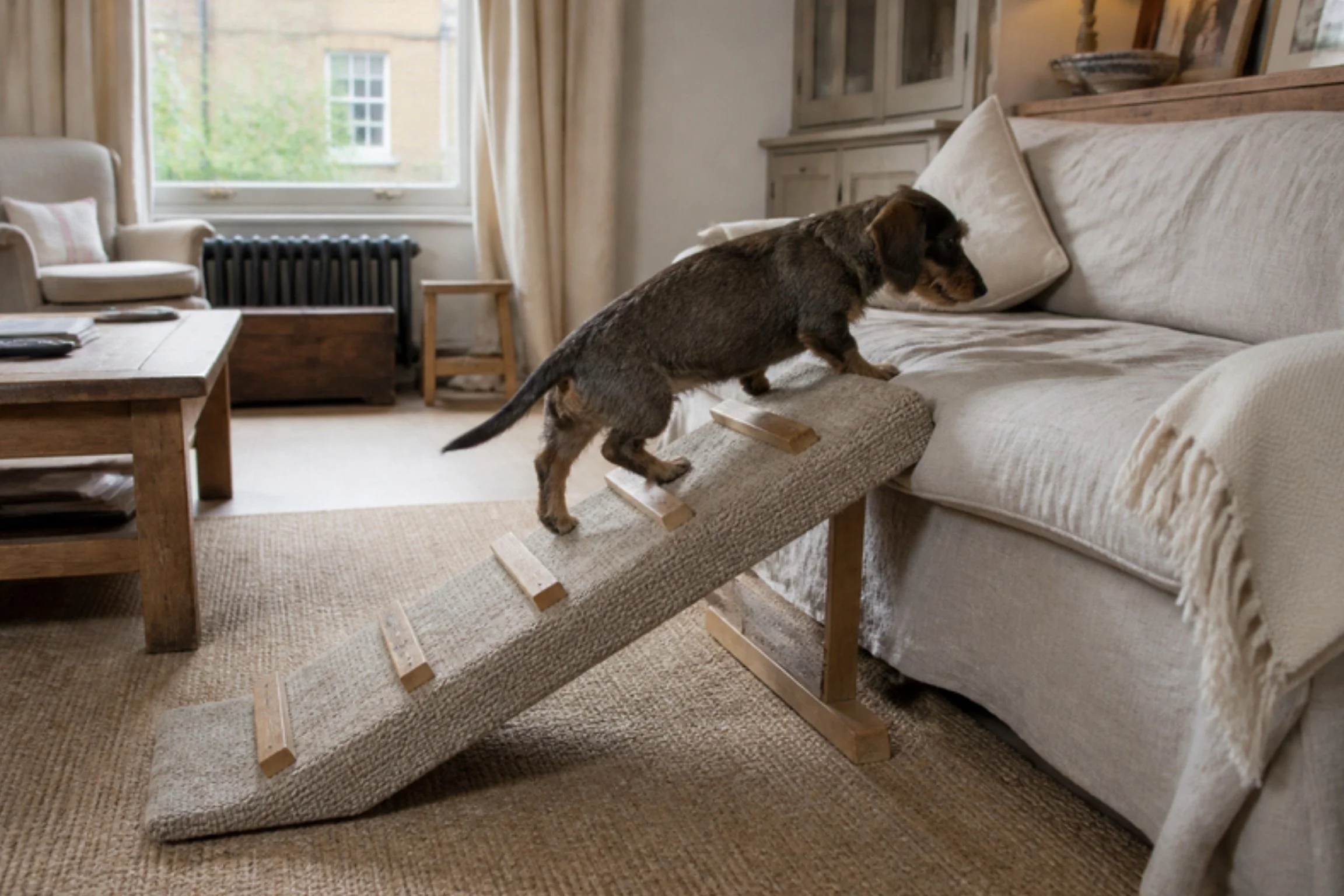
Every day, the back is shaped by small things. A lean body, so the spine carries only what it needs. A ramp to the sofa, the bed and the car, taught long before it's needed. Two hands, never one: under the chest and under the hindquarters, the spine level like a tray. A harness rather than a collar, and rugs on slippery floors. A steady walk each morning, not quiet weekdays and long weekend hikes. These are the rituals that carry a spine through a whole life.
What I see
IVDD and disc problems are among the things I see most often. How a dog recovers depends on how severe it is and how early care begins. Rest matters more than most families realise: far more rest, for far longer than expected. Recovery often takes months, so patience is part of the care.
The spine is more sensitive than most people realise. For a small dog, a bag without proper support can do more harm than good. During recovery, rest also means no outings in a stroller: its small, constant movements disturb the nerves and discs while they repair.
Even once a back has recovered, a weakness can remain. That is when steady, ongoing support matters. You come to know the back well, you notice the early signs sooner, and you can meet them calmly. And if your dog is one of the breeds most at risk, begin the daily rituals long before they are needed.
The wolf never leapt from a sofa. It walked, it trotted, it rested. Our dogs' backs ask for that same rhythm.
Lilo Ask-Henriksen, Holistic Animal Wellbeing, London. She trained as a veterinary nurse in Denmark, and was authorised and practised in Norway. Last reviewed 2 November 2026.
Research
Draper, W.E. et al. (2012) Low-level laser therapy reduces time to ambulation in dogs after hemilaminectomy: a preliminary study. Journal of Small Animal Practice 53(8), 465–469.
Bruno, E. et al. (2020) Perilesional photobiomodulation therapy and physical rehabilitation in post-operative recovery of dogs surgically treated for thoracolumbar disk extrusion. BMC Veterinary Research 16, 120.
Photobiomodulation for spinal cord injury: a systematic review and meta-analysis (2020). Physiology & Behavior.
Photobiomodulation, pain and return to play in injured athletes: a systematic review and meta-analysis (2024).
Runge, N. et al. (2024) The bidirectional relationship between sleep problems and chronic musculoskeletal pain. Pain.
Packer, R.M.A. et al. (2013) How long and low can you go? Effect of conformation on the risk of thoracolumbar intervertebral disc extrusion in domestic dogs. PLoS ONE 8(7), e69650.
Brown, E.A. et al. (2017) FGF4 retrogene on CFA12 is responsible for chondrodystrophy and intervertebral disc disease in dogs. PNAS 114(43), 11476–11481.
Dachshund Breed Council health surveys (2015, 2018, 2021), dachshund-ivdd.uk.
